
Ankle arthroscopy is a minimally invasive procedure used to diagnose and treat a range of ankle conditions. A thin camera called an arthroscope is used to examine and repair the inside of the joint through a small incision, reducing scarring and speeding recovery compared with traditional open surgery.

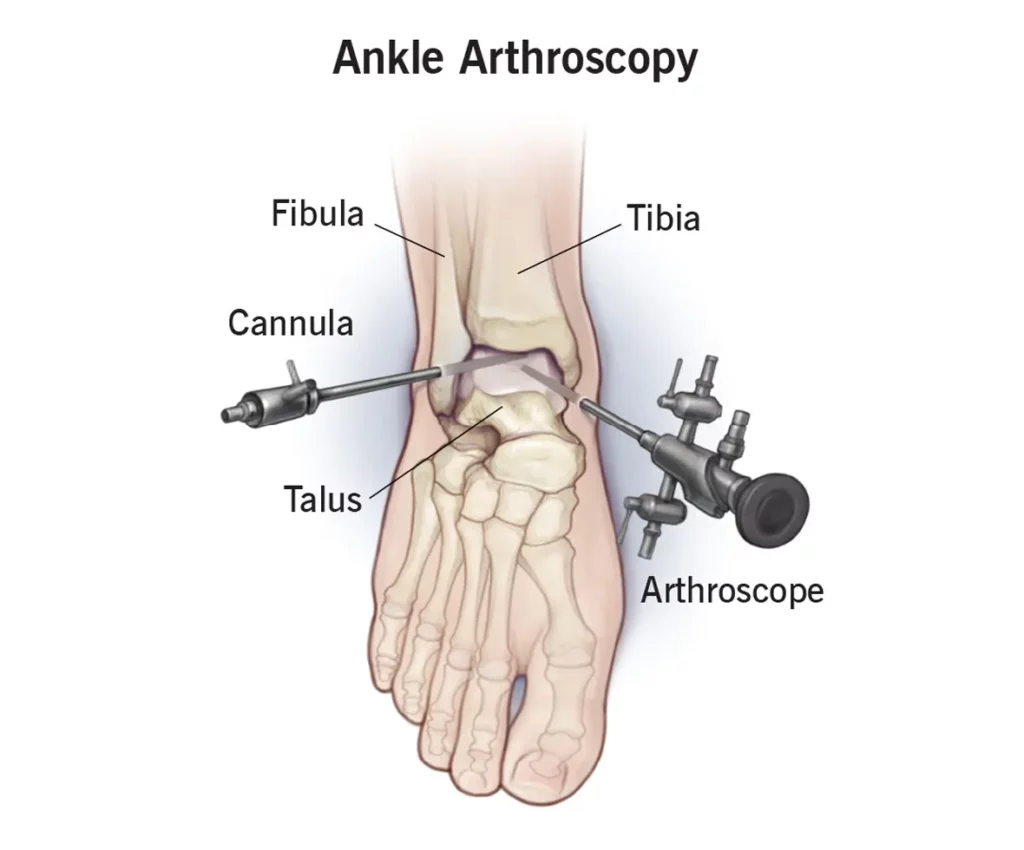
Ankle arthroscopy is commonly used to treat:
Arthritis
Inflammation of the ankle joint causing pain, stiffness, and limited mobility.
Cartilage damage
Worn or torn cartilage that leads to pain and stiffness.
Ankle impingement
Bones or soft tissue pinched in the joint, restricting movement.
Ligament tears
Torn ligaments such as the ATFL causing instability and pain.
Assessing and treating joint damage from ankle fractures.
Loose bodies
Fragments of bone or cartilage in the joint.

Ankle arthroscopy is typically an outpatient procedure:
Anesthesia
You are made comfortable for the procedure.
Small incisions
The arthroscope is inserted through a small incision.
Examine the joint
The camera gives a clear view of the inside of the ankle.
Repair
Small instruments repair or remove damaged tissue.
Recovery
Physical therapy may be prescribed to support rehabilitation.
Recovery varies with the extent of the procedure and your health.
Days to 1 week
Light activity
Most patients return to light activity.
Several weeks
Rehabilitation
Physical therapy restores strength and motion.
Weeks to months
Normal activity
A gradual return to full activity.
Ankle arthroscopy is a minimally invasive procedure that uses a thin tube with a camera, an arthroscope, to examine and repair the inside of the ankle joint through a small incision.
It is commonly used for ankle arthritis, cartilage damage, ankle impingement, ligament tears such as the anterior talofibular ligament (ATFL), and certain fractures.
Patients can typically return to light activity within a few days to a week and gradually return to normal activity over several weeks to a few months.
Physical therapy may be prescribed to help with rehabilitation. Following your surgeon's instructions helps ensure proper healing.
Potential complications include infection, bleeding or swelling, nerve damage, numbness or tingling in the ankle or foot, persistent pain, and scarring.
Yes. Ankle arthroscopy is usually performed as an outpatient procedure.
Small incisions mean less scarring, a clearer view of the joint for precise treatment, less discomfort, and a quicker return to daily activities.
An examination and imaging help determine whether ankle arthroscopy is appropriate. Use the form on this page or call (321) 499-4646.
Ankle arthroscopy offers:

How arthroscopic (keyhole) surgery of the ankle compares with traditional open surgery.
Ankle arthroscopy offers a clear view of the joint and a quicker return to daily activities than open surgery.
Hear our patients share their experience with us, All in their own words.
Expert, ultra-minimally invasive spine and orthopedic care, close to home.
Ultra-minimally invasive and endoscopic techniques
We specialize in procedures performed through incisions smaller than a dime, sparing muscle and supporting a faster recovery.
Same-day, outpatient procedures
Most patients walk in and return home within hours, rather than facing an overnight hospital stay.
Board-certified, fellowship-trained surgeons
Our team includes early leaders in endoscopic spine surgery.
A complimentary MRI review
Understand your diagnosis and options from a board-certified specialist before committing to any treatment.
Trusted by our community
More than 1,100 patient reviews at a 4.6-star average, and over 50,000 patients treated.
Experts in ankle care
Our physicians diagnose and treat all kinds of ankle conditions, including fractures and severe pain.
Comprehensive spine and orthopedic care
From injections to advanced procedures, your full continuum of care is handled in one place.
Convenient locations across the Space Coast and Orlando
Care close to home in Melbourne, Orlando (Lake Nona), and Titusville.