
Transforaminal lumbar interbody fusion (TLIF) relieves chronic lower back pain from a damaged, unstable disc. Our minimally invasive TLIF removes the disc, decompresses the nerve, and stabilizes the spine through a small incision, without the muscle disruption of traditional open back fusion.

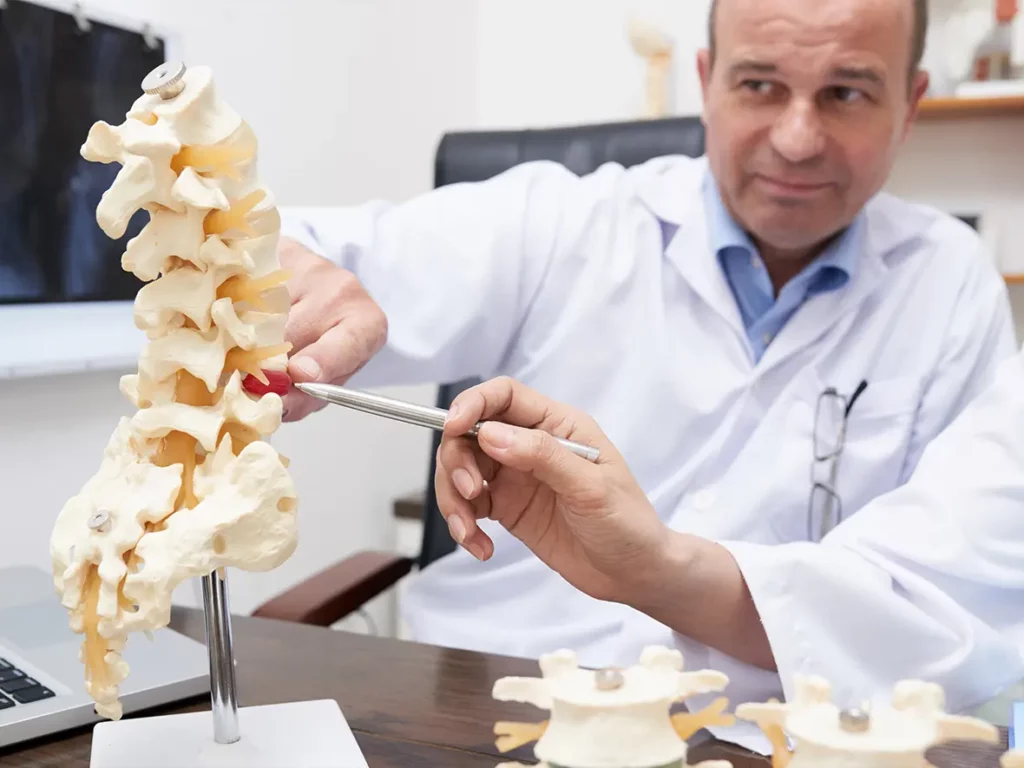
This procedure is designed to treat the chronic effects of some of the most common spine conditions:

A minimally invasive TLIF follows these steps:
Anesthesia
You are made comfortable under anesthesia.
A small side incision
An incision of less than one inch allows an approach that spares the back muscles.
Removing the disc and decompressing
The damaged disc is removed and the affected nerve is freed.
Graft and spacer
A bone graft and spacer are placed in the disc space for immediate stabilization.
Fusion
Over the following months, the vertebrae heal together into one solid segment.
Transforaminal lumbar interbody fusion (TLIF) removes a damaged lumbar disc, decompresses the affected nerve, and places a bone graft and spacer in the disc space so the vertebrae fuse into one stable segment.
Our TLIF is performed through a small incision of less than one inch, approaching the spine from the side to avoid disrupting the surrounding muscles and nerves, unlike traditional open back fusion.
TLIF is used for degenerative disc disease, herniated discs, spondylolisthesis, and spinal stenosis when the segment is unstable or a nerve is compressed.
Candidates typically have chronic lower back pain that has not improved with non-surgical treatment, along with degenerative disc disease, stenosis, or spondylolisthesis causing nerve compression.
The bone graft gradually fuses the vertebrae over several months. Many patients return to light activity within weeks, while the fusion continues to mature.
Fusion stops motion at the treated segment, which is often the source of pain. Most patients do not notice a meaningful loss of overall flexibility when a single level is fused.
Potential benefits include reduced chronic lower back pain, improved spinal stability, corrected alignment, and prevention of further degeneration of the affected disc.
Call to speak with one of our Patient Advocates, or request a free MRI review at (321) 499-4646.
TLIF treats radiating numbness, tingling, and pain, localized pain, and burning sensations. Potential benefits include:

How ultra-minimally invasive and endoscopic procedures compare with traditional open surgery, and why most patients recover faster.
Minimally invasive TLIF stabilizes the spine through a small incision, avoiding the muscle disruption and lengthy recovery of traditional open back fusion.
Hear our patients share their experience with us, All in their own words.
Expert, ultra-minimally invasive spine and orthopedic care, close to home.
Ultra-minimally invasive and endoscopic techniques
We specialize in procedures performed through incisions smaller than a dime, sparing muscle and supporting a faster recovery.
Same-day, outpatient procedures
Most patients walk in and return home within hours, rather than facing an overnight hospital stay.
Board-certified, fellowship-trained surgeons
Our team includes early leaders in endoscopic spine surgery.
A complimentary MRI review
Understand your diagnosis and options from a board-certified specialist before committing to any treatment.
Trusted by our community
More than 1,100 patient reviews at a 4.6-star average, and over 50,000 patients treated.
An alternative to open back fusion
Our TLIF is performed through a small incision that spares the surrounding muscles and nerves.
Comprehensive spine and orthopedic care
From injections to advanced procedures, your full continuum of care is handled in one place.
Convenient locations across the Space Coast and Orlando
Care close to home in Melbourne, Orlando (Lake Nona), and Titusville.