
Cervical Disc Replacement
Cervical disc replacement is a minimally invasive procedure in which a damaged disc in the neck is replaced with an artificial one. It relieves pressure on the nerves that causes neck, shoulder, and arm pain, and it preserves motion at the treated level. Our approach uses an incision of less than one inch and is often outpatient.

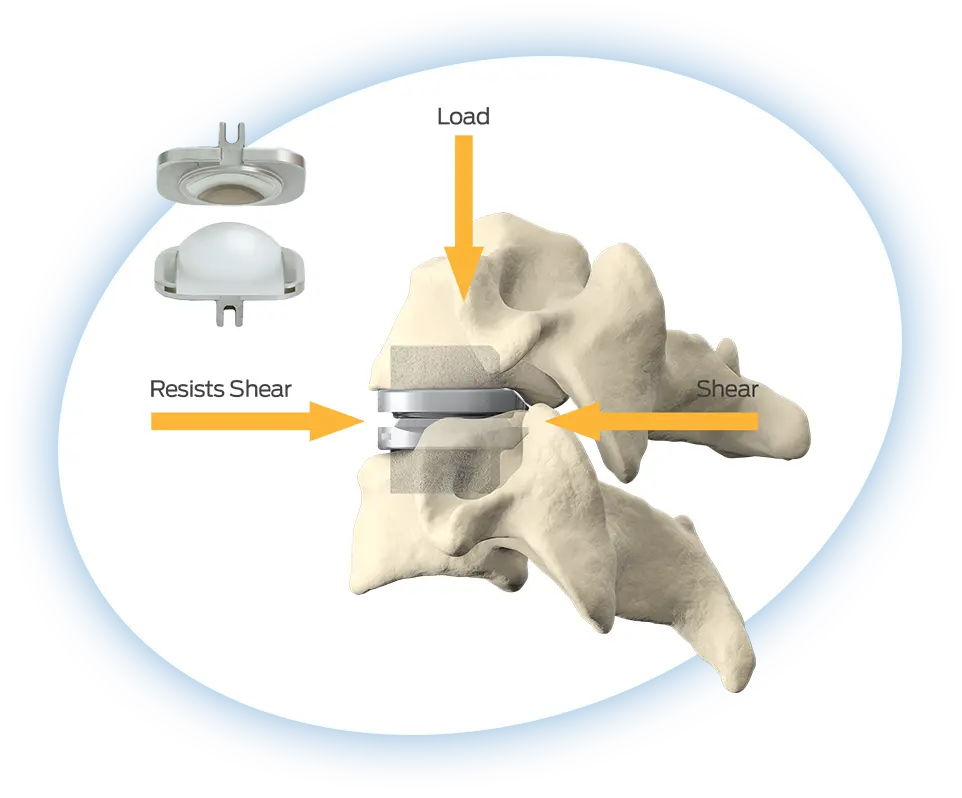
What Is Cervical Disc Replacement?
Conditions Disc Replacement Treats
This procedure is used for the following conditions. Each links to its own page with symptoms and other treatment options.
Am I A Candidate?

How Cervical Disc Replacement Works
The procedure follows these steps:
- 1
Anesthesia
You are made comfortable under anesthesia.
- 2
A small incision
An incision of less than one inch is made at the front of the neck, usually along a skin crease.
- 3
Removing the disc
Muscles are gently moved aside, and the damaged disc and any bone spurs pressing on the nerves are removed.
- 4
Placing the artificial disc
An artificial disc sized to your spine is inserted into the disc space under X-ray guidance.
- 5
Closing and recovery
The incision is closed; many patients go home the same day.
Disc Replacement Or Fusion?
Both procedures remove a damaged disc and relieve pressure on the nerve. They differ in what replaces it.
Cervical disc replacement
Motion preserving
An artificial disc keeps the level moving
- Maintains natural neck motion at the treated level.
- May reduce stress on neighboring discs.
- Best for selected patients without significant arthritis.
ACDF
Fusion
The two vertebrae heal into one segment
- Long-established and reliable.
- Suited to multiple levels, arthritis, or instability.
- Learn more about ACDF.
Your surgeon will review which option fits your anatomy and the number of levels involved.
Frequently Asked Questions
What is cervical disc replacement?
Cervical disc replacement removes a damaged disc in the neck and replaces it with an artificial disc that relieves pressure on the nerves while preserving motion at that level.
How is disc replacement different from fusion (ACDF)?
Both remove the damaged disc through the front of the neck. ACDF fuses the two vertebrae together, while disc replacement uses an artificial disc that keeps the level moving, which may reduce stress on neighboring discs.
Who is a good candidate?
Candidates typically have arm pain, numbness, or weakness from a damaged disc at one or two levels, without significant arthritis of the facet joints, instability, or osteoporosis. An MRI and examination determine candidacy.
Is cervical disc replacement an outpatient procedure?
Yes, in many cases. Our minimally invasive approach uses an incision of less than one inch and is often performed on an outpatient basis.
How long is recovery?
Many patients return to light activity and desk work within a couple of weeks, without the lengthy recovery associated with open neck surgery. Your surgeon will guide your return to heavier activity.
Will I have neck motion after the procedure?
Preserving motion is a key goal of disc replacement. The artificial disc is designed to move like a natural disc at the treated level.
What symptoms does cervical disc replacement relieve?
It relieves symptoms caused by a diseased cervical disc, including neck pain and stiffness, headaches, radiating shoulder and arm pain, weakness, and numbness or tingling in the arm or fingers.
How do I find out if I am a candidate?
Our Patient Advocates can arrange a review of your most recent MRI and medical history. Request a free MRI review or call (321) 499-4646.
Symptoms Disc Replacement Can Relieve
Symptoms caused by a diseased cervical disc vary with the individual and the condition. The most common include:
- Neck pain and stiffness.
- Headaches.
- Radiating pain in the shoulder and arm.
- Muscle weakness in the shoulder, arm, or hand.
- Tingling or numbness in the arm or fingers.

Related Treatments
Minimally Invasive Vs. Open Neck Surgery
The Minimally Invasive Advantage
How ultra-minimally invasive and endoscopic procedures compare with traditional open surgery, and why most patients recover faster.
Our minimally invasive disc replacement uses an incision of less than one inch, is often outpatient, and avoids the lengthy recovery of open neck surgery.
Our Patients Stories
Hear our patients share their experience with us, All in their own words.
Why Choose Total Spine and Orthopedics
Expert, ultra-minimally invasive spine and orthopedic care, close to home.
Ultra-minimally invasive and endoscopic techniques
We specialize in procedures performed through incisions smaller than a dime, sparing muscle and supporting a faster recovery.
Same-day, outpatient procedures
Most patients walk in and return home within hours, rather than facing an overnight hospital stay.
Board-certified, fellowship-trained surgeons
Our team includes early leaders in endoscopic spine surgery.
A complimentary MRI review
Understand your diagnosis and options from a board-certified specialist before committing to any treatment.
Trusted by our community
More than 1,100 patient reviews at a 4.6-star average, and over 50,000 patients treated.
Motion-preserving neck surgery
Disc replacement keeps the treated level moving, as an alternative to fusion for the right patients.
Comprehensive spine and orthopedic care
From injections to advanced procedures, your full continuum of care is handled in one place.
Convenient locations across the Space Coast and Orlando
Care close to home in Melbourne, Orlando (Lake Nona), and Titusville.
Schedule your visit online