
When hip pain interferes with daily life and is not helped by conservative treatments such as pain management or injections, total hip replacement replaces the damaged joint with an implant to reduce or eliminate pain. Our surgeons use minimally invasive techniques, with same-day, outpatient surgery for select candidates.

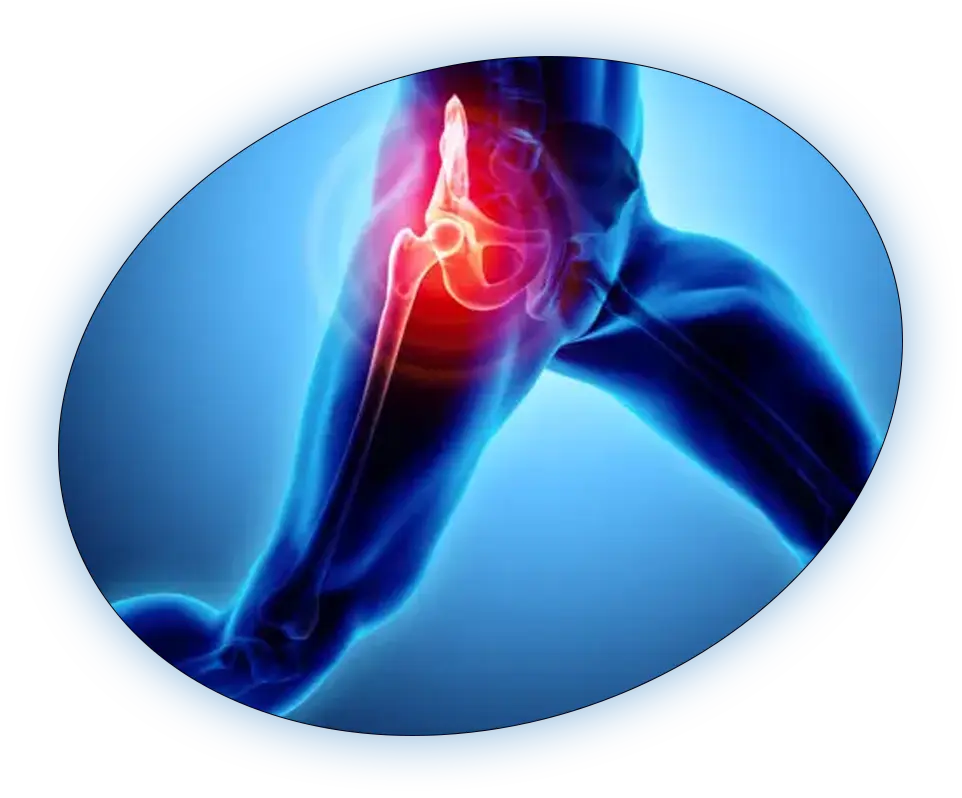
Hip replacement is one of the most successful procedures in all of medicine, but it is never the first step. Care begins with the least invasive options, and surgery is recommended only when hip damage no longer responds to them.
Conditions it treats
Tried first, when appropriate
When these no longer control your pain, or when imaging shows the joint is worn beyond repair, a hip replacement can restore comfortable, reliable movement. Your surgeon will always recommend the least invasive option appropriate for you.

A total hip replacement resurfaces the worn joint with a durable implant. Our team uses minimally invasive techniques throughout. Here is what the procedure involves, step by step.
You are placed under anesthesia and monitored throughout, so the procedure itself is painless.
Your comfort and safety are managed by the care team from start to finish.
Working through a smaller incision with specialized instruments, the surgeon accesses the hip while sparing the surrounding muscle and soft tissue.
Less disruption to muscle and tissue is what drives the reduced pain and faster recovery of a minimally invasive approach.
The worn femoral head (the ball) and the damaged cartilage in the socket are removed.
Taking out the arthritic surfaces is what ends the bone-on-bone pain you have been living with.
A new socket liner and a ball on a stem are fitted precisely, recreating a smooth, natural-feeling joint.
The new joint is designed to move smoothly and restore comfortable, reliable function.
The incision is closed, and a guided recovery plan with physical therapy begins.
A structured recovery is central to a strong, lasting result.
Your surgeon will walk you through the details of your procedure, including the approach and what your hospital course is likely to look like.
Hip replacement may be right for you when these ring true, and when less invasive care can no longer keep you comfortable. The surest way to know is a conversation with an orthopedic specialist.
Deep hip or groin pain
Aching that lingers with walking, stairs, or at rest, and often disturbs your sleep.
Conservative care isn’t enough
Physical therapy, medication, and injections no longer control your symptoms.
Imaging shows joint damage
X-rays reveal advanced arthritis or bone-on-bone wear in the hip joint.
Stiffness and a limp
Trouble putting on socks or shoes, reduced range of motion, or leaning on a cane to get around.
Your life has shrunk around it
You’ve given up activities, hobbies, or travel you love because of your hip.
You’re in good general health
Overall health supports surgery and healing, something we assess together during your evaluation.
Recognize yourself here? Schedule a consultation and we’ll review your imaging and every option with you.
Hip replacement is considered when hip or groin pain limits your daily life or sleep, X-rays show advanced joint damage, and conservative care such as physical therapy, medication, and injections is no longer keeping you comfortable. The clearest way to know is an evaluation with an orthopedic specialist, who will review your imaging and options with you. Total Spine and Orthopedics offers a consultation to determine whether you are a candidate.
In a total hip replacement, the worn surfaces of the joint, the ball at the top of the thighbone and the socket it sits in, are removed and replaced with a durable implant that recreates a smooth, natural-feeling joint. Our team performs the procedure using minimally invasive techniques, and your surgeon will explain what to expect based on your anatomy and health.
Minimally invasive total hip replacement uses smaller incisions and specialized instruments instead of one large incision, with less disruption of the surrounding muscle and soft tissue. For most patients that means significantly less postoperative pain, faster healing, and a shorter hospital stay than traditional surgery.
Sometimes. For select candidates, hip replacement may be performed on a same-day, outpatient basis, and a minimally invasive approach typically means a shorter hospital stay overall. Your surgeon will confirm what is appropriate for your health and your procedure.
A minimally invasive hip replacement generally means less pain and a faster recovery than traditional surgery. Guided movement and physical therapy begin soon after surgery, walking aids are set aside over the following weeks, and everyday activities return during that time. The hip continues to strengthen over the following months. Your surgeon and physical therapist will guide your individual timeline.
The most common reason is osteoarthritis, the gradual wearing away of the hip joint’s cartilage. Hip replacement also treats rheumatoid and post-traumatic arthritis, avascular necrosis (loss of blood supply to the bone), hip fractures, and hip dysplasia when these cause pain and damage that no longer respond to conservative care.
Yes. During the healing period your surgeon will give you clear, personalized guidance on what to do and what to avoid to protect the new joint. These guidelines are tailored to your procedure and your progress.
The procedure itself is performed under anesthesia, so you feel nothing during surgery. Recovery involves some discomfort that is managed with modern pain protocols, and many patients find that the arthritis pain they lived with beforehand eases as they heal.
Hip arthritis tends to build slowly, so it’s easy to adapt to the pain without realizing how much it has taken. These are the signs it may be time to talk to a specialist:

A minimally invasive hip replacement generally means less pain and a faster recovery than traditional surgery. Every recovery is individual, the timeline below is a general guide, and your surgeon and physical therapist will tailor the plan to you.
Guided movement and physical therapy begin soon after surgery. Depending on your case, you may go home the same day or after a shorter stay than traditional surgery requires.
Follow your team’s guidance and begin gentle activity as directed.
You move around with a walker or cane while the hip heals, and the arthritis pain you had before often begins to ease.
Attend physical therapy and follow your activity guidance closely.
Walking aids are gradually set aside and many everyday activities return, at a pace your surgeon confirms.
Keep building strength and range of motion steadily through therapy.
The hip continues to strengthen, and the full benefits of the surgery are typically felt over the following months.
Stay active and keep your follow-up visits so we can confirm you’re on track.
Contact your care team promptly about fever, increasing redness or drainage, calf pain or swelling, or pain that is not improving.
Traditional hip replacement has long been effective, but advances in surgical technique have made the minimally invasive version an excellent option. Both use the same durable implant, the difference is how the joint is reached, and how that shapes recovery.
For the right candidate, the minimally invasive approach means less pain, a shorter stay, and a faster return to the life you’ve been missing.
Not every patient is a candidate for every technique. Your surgeon will recommend the approach that fits your anatomy and health.
Hear our patients share their experience with us, All in their own words.
Expert, ultra-minimally invasive spine and orthopedic care, close to home.
Ultra-minimally invasive and endoscopic techniques
We specialize in procedures performed through incisions smaller than a dime, sparing muscle and supporting a faster recovery.
Same-day, outpatient procedures
Most patients walk in and return home within hours, rather than facing an overnight hospital stay.
Board-certified, fellowship-trained surgeons
Our team includes early leaders in endoscopic spine surgery.
A complimentary MRI review
Understand your diagnosis and options from a board-certified specialist before committing to any treatment.
Trusted by our community
More than 1,100 patient reviews at a 4.6-star average, and over 50,000 patients treated.
Same-day joint replacement for select candidates
Our surgeons offer outpatient, same-day hip replacement when it is safe for you.
Comprehensive spine and orthopedic care
From injections to advanced procedures, your full continuum of care is handled in one place.
Convenient locations across the Space Coast and Orlando
Care close to home in Melbourne, Orlando (Lake Nona), and Titusville.