
The SI joint connects the base of the spine to the pelvis, and chronic SI joint pain can make standing and walking difficult. Our minimally invasive SI joint fusion stabilizes the joint through a small incision to relieve pain at its source, for patients whose symptoms have not improved with conservative care.

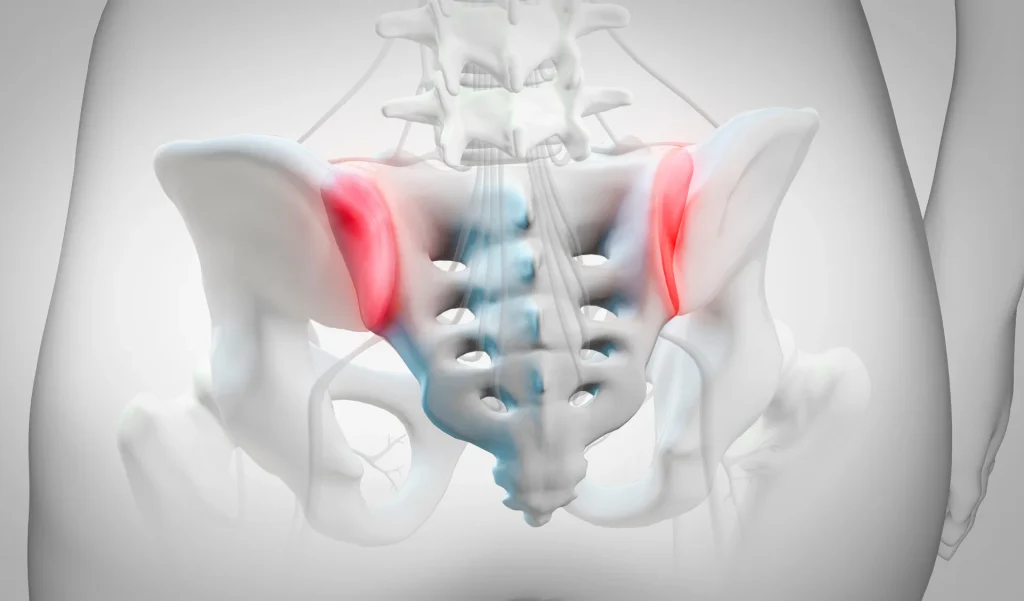
The best way to determine the cause is an MRI of the SI joint and lumbar area and a comprehensive analysis. Common causes include:
Wear of the SI joint cartilage.
Spondylitis
Inflammatory arthritis affecting the spine and SI joints.
Injury
A fall or misstep that strains the joint.
Previous lumbar fusion
Extra stress on the SI joint after fusion; see pain after surgery.
Uneven leg length
Loads one joint more than the other.
Uneven hip alignment
Changes the forces across the joint.

A minimally invasive SI joint fusion follows these steps:
Confirming the source
A diagnostic injection confirms the SI joint is causing your pain.
Anesthesia
You are made comfortable for the procedure.
A small incision
A small incision gives access to the joint with minimal muscle disruption.
Placing implants
Implants are placed across the joint under X-ray guidance to stabilize it.
Fusion over time
The bones gradually fuse, and physical therapy restores strength.
SI joint fusion is a minimally invasive procedure that stabilizes a painful sacroiliac joint, the joint that connects the base of the spine to the pelvis, so the bones heal together and painful motion stops.
The lumbar spine sits immediately above the SI joint, and the two cause similar low back and buttock pain. A careful examination and diagnostic injection help tell them apart.
Candidates have chronic SI joint pain confirmed by examination and a diagnostic injection, which has not improved with physical therapy, medication, and SI joint injections.
Through a small incision, implants are placed across the SI joint under X-ray guidance to stabilize it while the bones fuse over time.
Common causes include arthritis, spondylitis, an injury from a fall or misstep, a previous lumbar fusion, uneven leg length, and uneven hip alignment.
It relieves pain in the SI joint and the surrounding areas, including the lower back, buttocks, pelvis, and thighs, as well as difficulty walking or standing and stiffness.
Many patients walk with some protection, such as crutches, for a short period, then progress through physical therapy over the following weeks as the joint fuses.
An MRI of the SI joint and lumbar area and an in-person evaluation help determine the best option. Request a free MRI review or call (321) 499-4646.
The most common symptom treated is pain in the SI joint itself, which can radiate to the thighs, buttocks, pelvis, and lower back. Other symptoms include:

How ultra-minimally invasive and endoscopic procedures compare with traditional open surgery, and why most patients recover faster.
Minimally invasive SI joint fusion treats the condition at its source through a small incision, with less muscle disruption than traditional open surgery.
Hear our patients share their experience with us, All in their own words.
Expert, ultra-minimally invasive spine and orthopedic care, close to home.
Ultra-minimally invasive and endoscopic techniques
We specialize in procedures performed through incisions smaller than a dime, sparing muscle and supporting a faster recovery.
Same-day, outpatient procedures
Most patients walk in and return home within hours, rather than facing an overnight hospital stay.
Board-certified, fellowship-trained surgeons
Our team includes early leaders in endoscopic spine surgery.
A complimentary MRI review
Understand your diagnosis and options from a board-certified specialist before committing to any treatment.
Trusted by our community
More than 1,100 patient reviews at a 4.6-star average, and over 50,000 patients treated.
Treating SI joint pain at its source
We confirm the SI joint as the pain generator before recommending fusion.
Comprehensive spine and orthopedic care
From injections to advanced procedures, your full continuum of care is handled in one place.
Convenient locations across the Space Coast and Orlando
Care close to home in Melbourne, Orlando (Lake Nona), and Titusville.