
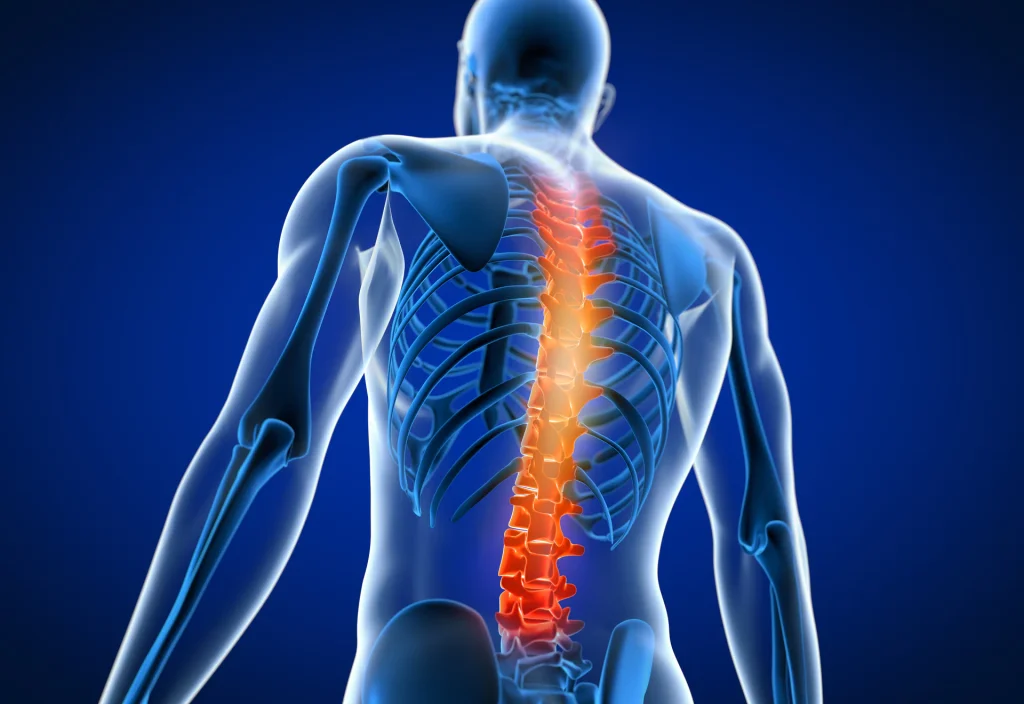
Back pain is one of the most common medical complaints in the United States. In fact, millions of Americans experience significant back pain each year that interferes with work, physical activity, and overall quality of life. But identifying the true cause of back pain is often more complicated than it may seem.
Many patients assume that an MRI or X-ray will immediately reveal the answer when in reality it is often just one step that our spine specialists take.
At Total Spine & Orthopedics, physicians use a systematic and patient focused approach to pinpoint the underlying cause of a patient’s pain so the most effective treatment plan can be developed.
Why Identifying the Exact Source of Back Pain Matters
Not all back pain originates from the same structure. The spine is made up of many different components, including:
- Intervertebral discs
- Facet joints
- Spinal nerves
- Muscles and ligaments
- The sacroiliac (SI) joints
- Vertebral bones
Pain can originate from any of these structures, and each requires a different treatment strategy. Treating the wrong structure can lead to ineffective care and prolonged symptoms.
For example, pain caused by a herniated disc may require a very different approach than pain coming from the facet joints or the sacroiliac joint. That is why accurately identifying the pain generator is one of the most important steps in spine care.
Step 1: A Detailed Medical History
The process begins with a thorough conversation about the patient’s symptoms. Spine specialists carefully evaluate several factors, including:
- When the pain started
- Whether the pain developed suddenly or gradually
- Activities that worsen or relieve the pain
- Whether the pain radiates into the arms or legs
- Previous injuries or spine problems
Certain symptom patterns can offer important clues. For example, leg pain that travels below the knee may suggest nerve compression, while pain that worsens with twisting or standing may indicate involvement of the facet joints.
Step 2: A Comprehensive Physical Examination
Next, the physician performs a detailed physical examination to evaluate how the spine and surrounding structures are functioning.
During the exam, spine specialists assess many things potentially including:
- Range of motion of the spine
- Areas of tenderness or muscle tightness
- Strength in the arms and legs
- Reflexes and nerve function
- Walking and posture
Specific physical tests can help identify whether pain is coming from the discs, nerves, joints, or muscles. For instance, raising the leg while the patient is lying down can help determine whether a spinal nerve may be irritated or compressed.
Step 3: Advanced Imaging Studies
If necessary, imaging studies are used to visualize the structures of the spine. The most common studies include:
MRI (Magnetic Resonance Imaging)
MRI scans are often the most useful tool for evaluating soft tissues such as:
- Herniated or bulging discs
- Annular tears
- Nerve compression
- Spinal stenosis
CT Scan
CT scans provide detailed images of the bony structures of the spine and can be helpful in certain complex cases.
X-rays
X-rays are often used to evaluate spinal alignment, fractures, or degenerative changes.
However, imaging findings must always be interpreted carefully. Many people have abnormalities on XRay or MRI scans that do not actually cause pain. That is why imaging results must always be correlated with symptoms and physical exam findings.
Step 4: Diagnostic Injections
When the exact pain generator is still unclear, physicians may use diagnostic injections. These specialized procedures are one of the most precise tools available for identifying the source of spine pain.
During a diagnostic injection, a small amount of local anesthetic is placed into a specific structure in the spine.
Examples include:
- Facet joint injections
- Medial branch nerve blocks
- Sacroiliac (SI) joint injections
- Selective nerve root blocks
If the patient experiences significant temporary pain relief after the injection, it strongly suggests that the targeted structure is responsible for the pain.
Diagnostic injections are extremely valuable because they allow physicians to confirm the pain source before moving forward with treatment.
Step 5: Developing a Targeted Treatment Plan
Once the source of pain has been identified, a personalized treatment plan can be created. In many cases, surgery is not necessary. Treatment options may include:
- Physical therapy and rehabilitation
- Targeted spinal injections
- Interventional pain management procedures
- Minimally invasive spine treatments
When surgery is required, modern techniques such as endoscopic or ultra-minimally invasive spine surgery can often address the problem with smaller incisions, less tissue disruption, and faster recovery times.
Why a Specialist Evaluation Is Important
Back pain is rarely a one-size-fits-all condition. Two patients may have similar symptoms but completely different underlying causes.
That is why evaluation by a spine specialist is so important. Experienced spine physicians use a combination of clinical expertise, advanced diagnostics, and modern technology to identify the true pain generator and recommend the most appropriate treatment.
Finding Expert Spine Care in Florida
Patients throughout Melbourne, Orlando, and the surrounding communities can rest easy knowing the talented team at Total Spine & Orthopedics is standing by to help them get out of pain. Our practice combines board-certified spine specialists, advanced diagnostic tools, and the latest minimally invasive treatment options to help patients return to an active, pain-free life.
Schedule a consultation with Total Spine & Orthopedics today to learn more about the advanced diagnostic and treatment options and most importantly to start down your road to eliminating the root causes of your pain.
Disclaimer: This article is for informational purposes only and is not a replacement for evaluation by a licensed physician.