
Toe deformities such as hammertoe, claw toe, and mallet toe are common conditions that can cause pain, corns, calluses, and difficulty finding shoes that fit. They are often caused by imbalances in the muscles and tendons that control the toe. Conservative care can ease symptoms, and minimally invasive correction can restore alignment when the deformity becomes rigid.

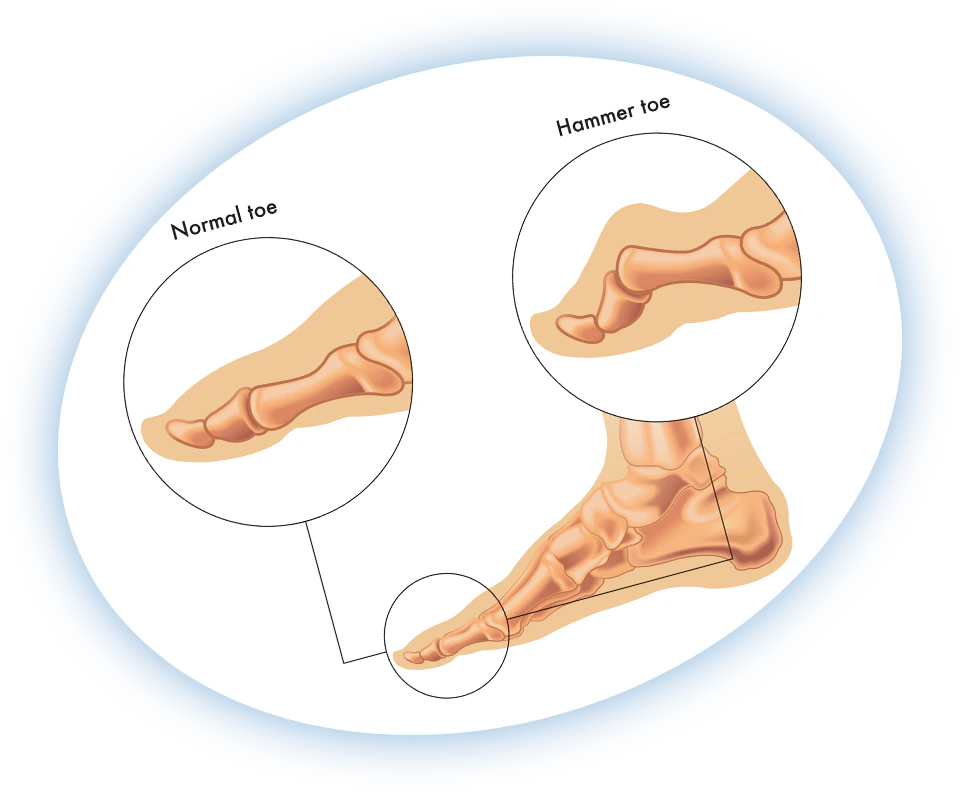
Conservative treatments can reduce symptoms but rarely correct the deformity once it becomes rigid. That is where minimally invasive correction comes in.
Conservative care
Minimally invasive procedures
These approaches aim to restore a more natural alignment, relieve pressure points, and improve comfort and function.

Toe deformities usually result from a muscle and tendon imbalance. Contributing factors include:
Tight or narrow footwear
Crowds the toes into a bent position.
Muscle and tendon imbalance
Uneven pull bends the toe joints.
Arthritis
Damages the toe joints and their alignment.
Genetics
Inherited foot shape, such as a long second toe.
Bunions
A drifting big toe crowds the smaller toes.
Nerve conditions
Diabetes and neuropathy can cause claw toes.
A hammertoe is a toe that bends abnormally at the middle joint, creating a hammer-like shape. Related deformities include claw toe and mallet toe.
A hammertoe bends at the middle joint, a mallet toe bends at the joint nearest the tip, and a claw toe bends at both the middle and end joints while the base joint lifts up.
Hammertoes are often caused by imbalances in the muscles and tendons that control the toe, sometimes worsened by arthritis, genetics, a bunion, or tight footwear.
Shoe changes, padding, and exercises can reduce symptoms, especially while the toe is flexible, but they rarely correct the deformity once it becomes rigid.
Benefits may include less disruption to soft tissues, reduced pain, smaller scars, a lower risk of wound complications, and a faster return to normal activities than open surgery.
Yes. Hammertoes tend to worsen over time, moving from flexible to rigid. Addressing them early improves comfort and the likelihood of a successful minimally invasive correction.
Most patients transition to supportive footwear and resume normal activities sooner than after open surgery. Custom footwear or orthotics and physical therapy may be recommended.
Our foot and ankle team treats toe deformities in Melbourne, Orlando (Lake Nona), and Titusville. Call (321) 499-4646 to schedule.
Instead of large incisions, these procedures use very small openings and specialized instruments. Benefits may include:

Because the surgery is minimally invasive, patients typically experience a smoother recovery than with traditional open techniques.
After surgery
Protected walking
A surgical shoe protects the correction while it heals.
Recovery
Back to supportive shoes
Most transition to supportive footwear and resume normal activities sooner, though this varies.
Long term
Protect the alignment
Custom footwear or orthotics reduce recurrence, and therapy restores flexibility, balance, and gait.
This page is for informational purposes only and is not a replacement for consultation with a licensed physician.
Hear our patients share their experience with us, All in their own words.
Expert, ultra-minimally invasive spine and orthopedic care, close to home.
Ultra-minimally invasive and endoscopic techniques
We specialize in procedures performed through incisions smaller than a dime, sparing muscle and supporting a faster recovery.
Same-day, outpatient procedures
Most patients walk in and return home within hours, rather than facing an overnight hospital stay.
Board-certified, fellowship-trained surgeons
Our team includes early leaders in endoscopic spine surgery.
A complimentary MRI review
Understand your diagnosis and options from a board-certified specialist before committing to any treatment.
Trusted by our community
More than 1,100 patient reviews at a 4.6-star average, and over 50,000 patients treated.
Early evaluation of toe deformities
Addressing the problem early improves comfort and the likelihood of a successful minimally invasive correction.
Comprehensive spine and orthopedic care
From injections to advanced procedures, your full continuum of care is handled in one place.
Convenient locations across the Space Coast and Orlando
Care close to home in Melbourne, Orlando (Lake Nona), and Titusville.