
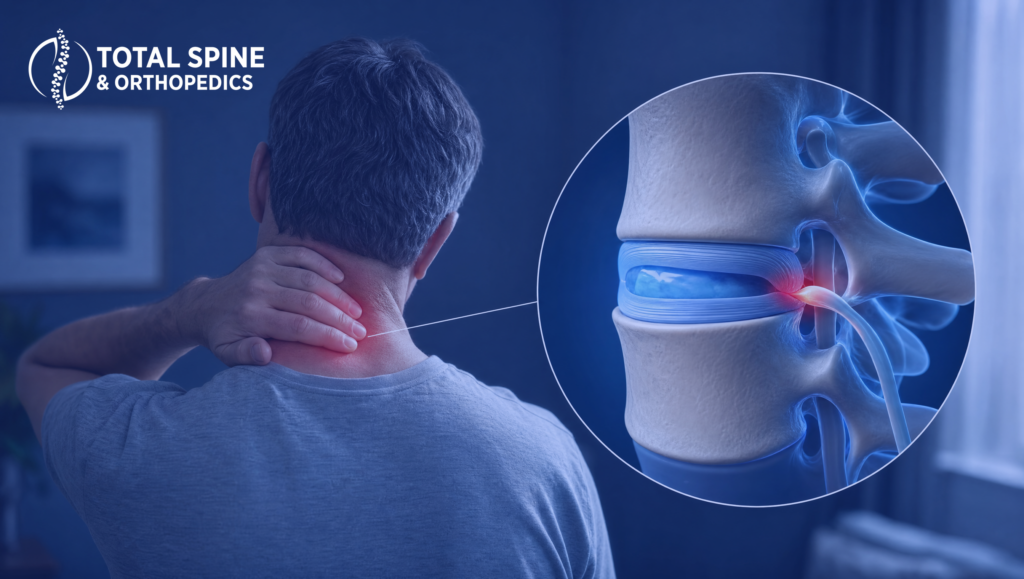
If you have been told you have a disc problem at C5-C6, you are in good company. C5-C6 is one of the most commonly affected levels in the entire spine. Sitting low in the neck, the C5-C6 segment handles a large share of the bending and turning your head does every day, and all of that motion adds up. When the disc at this level wears down, bulges, or herniates, the result is often a combination of neck pain and symptoms that travel down the arm.
The good news: most C5-C6 problems improve without surgery, and when surgery is needed, modern minimally invasive techniques allow many patients to go home the same day. Here is what you should know about this hardworking level of your spine.
Understanding the C5-C6 Region
The cervical spine is made up of seven vertebrae, labeled C1 through C7. The C5 and C6 vertebrae sit in the lower half of the neck, separated by the C5-C6 intervertebral disc, a cushion of cartilage that absorbs shock and allows smooth movement. Because the lower cervical levels bear more load and motion than the levels above them, C5-C6 is one of the most frequent sites of disc herniation and degenerative change in the neck.
The C6 Nerve Root: Why Symptoms Travel Down the Arm
At each level of the spine, a pair of nerve roots exits the spinal canal. The nerve that exits at C5-C6 is the C6 nerve root, and it follows a well-defined path:
- Sensation: The C6 nerve supplies feeling along the thumb side of the forearm, down into the thumb and index finger.
- Movement: It helps power the biceps (bending the elbow) and the muscles that bend the wrist back.
This is why a pinched nerve at C5-C6 so often causes tingling or numbness in the thumb and index finger, or a feeling of weakness when lifting or gripping. The symptoms simply follow the nerve’s route.
Common Conditions That Affect C5-C6
Herniated Disc
A herniated disc occurs when the soft inner core of the disc pushes through a tear in its tougher outer ring and presses on the spinal cord or the C6 nerve root. At C5-C6, this can happen suddenly, after an awkward lift, a fall, or a car accident, or gradually as the disc dries out with age.
Degenerative Disc Disease and Bone Spurs
Over the years, the C5-C6 disc naturally loses water content and height. As the disc flattens, the joints around it take on extra stress, and the body may respond by forming bone spurs (a process called cervical spondylosis). These changes can stiffen the neck and crowd the nearby nerves.
Foraminal and Spinal Stenosis
The openings where nerves exit the spine (the foramina) can narrow due to disc collapse, bone spurs, or thickened ligaments, a condition called foraminal stenosis. When the central canal itself narrows and presses on the spinal cord, more serious symptoms can develop, including clumsiness in the hands and trouble with balance. Those symptoms deserve prompt evaluation by a spine specialist.
Symptoms of a C5-C6 Problem
Every patient is a little different, but common signs include:
- Aching or sharp neck pain, often worse with certain head positions
- Pain radiating through the shoulder, down the arm, and toward the thumb
- Tingling or numbness in the thumb and index finger
- Weakness in the biceps or wrist, or a weaker grip
- Headaches or muscle tightness at the base of the neck
If you notice hand clumsiness, balance problems, or changes in bowel or bladder control, seek medical care right away, as these can be signs of spinal cord compression.
How C5-C6 Conditions Are Diagnosed
Diagnosis starts with a physical exam that tests your strength, reflexes, and sensation, which helps pinpoint which nerve is involved. An MRI is the gold standard for confirming the diagnosis because it shows the discs, nerves, and spinal cord in detail. If you already have an MRI, Total Spine and Orthopedics offers a free MRI review, where our specialists will look at your imaging and explain exactly what is happening at your C5-C6 level and what your options are.
Non-Surgical Treatment Comes First
Most C5-C6 problems are treated successfully without an operation. Depending on your symptoms, your care plan may include:
- Physical therapy: Targeted exercises that strengthen the neck and improve posture take pressure off the injured disc.
- Medications: Anti-inflammatories can calm pain and swelling during a flare-up.
- Epidural steroid injections: Image-guided injections deliver anti-inflammatory medication directly to the irritated C6 nerve, often providing months of relief and a window for therapy to work.
Minimally Invasive Surgical Options at C5-C6
When weeks of conservative care have not controlled the pain, or when weakness or spinal cord compression is present, surgery may be recommended. C5-C6 is one of the most common levels for these procedures, and each can be performed using modern, minimally invasive techniques:
- Anterior Cervical Discectomy and Fusion (ACDF): Through a small incision at the front of the neck, the damaged disc is removed and the space is stabilized with a spacer. ACDF has decades of proven results at C5-C6.
- Cervical Disc Replacement: Instead of fusing the level, the damaged disc is replaced with an artificial disc that preserves natural neck motion. Curious how the two compare? Read our guide on total disc replacement vs. ACDF.
- Foraminotomy: A keyhole procedure that gently enlarges the opening where the C6 nerve exits, relieving pressure while leaving the disc in place.
- Endoscopic decompression: Using an incision smaller than a dime, a high-definition camera guides the removal of the disc fragment or bone spur pressing on the nerve.
Recovery After C5-C6 Surgery
With minimally invasive techniques, most patients walk within hours of surgery and go home the same day or after one night. Many return to desk work within one to two weeks, with more physical activities added gradually under your surgeon’s guidance. Because the incisions are small and muscle is spared rather than cut, patients typically need less pain medication and get back to normal life faster than with traditional open surgery.
Frequently Asked Questions About C5-C6
Is a C5-C6 disc herniation serious?
Usually not. Most cases improve with conservative care over six to twelve weeks. It becomes more urgent if you develop progressive weakness, hand clumsiness, balance trouble, or bowel or bladder changes, which can signal pressure on the spinal cord.
Why do my thumb and index finger tingle?
The C6 nerve root, which exits the spine at C5-C6, carries sensation to the thumb side of the hand. When a disc or bone spur presses on that nerve, tingling and numbness show up along its path, even though the problem is in your neck.
Do I need a fusion, or can the disc be replaced?
It depends on your anatomy, the condition of the joints at that level, and your activity goals. Many C5-C6 patients are candidates for motion-preserving disc replacement, while others are better served by ACDF. A spine specialist can review your MRI and walk you through both options.
Why Choose Total Spine and Orthopedics?
Our board-certified surgeons specialize in ultra-minimally invasive and endoscopic spine care, performing same-day procedures through incisions measured in millimeters. With offices in Melbourne and Lake Nona (Greater Orlando), relief is close to home for patients across Central Florida and the Space Coast.
If neck pain or arm symptoms are interfering with your life, don’t wait for them to get worse. Call 321-499-4646 or schedule online today, and ask about our free MRI review.
Note: This article is for informational purposes and does not replace the advice of a licensed physician. Please consult with a licensed physician before attempting any treatment regimen.
Take Back Your Quality of Life!