
Anterior cervical discectomy and fusion (ACDF) relieves neck and arm pain caused by a damaged or herniated disc in the neck. Through a small incision at the front of the neck, the surgeon removes the problem disc, relieves pressure on the nerve or spinal cord, and stabilizes the segment. We reserve ACDF for cases a less invasive route cannot safely resolve.

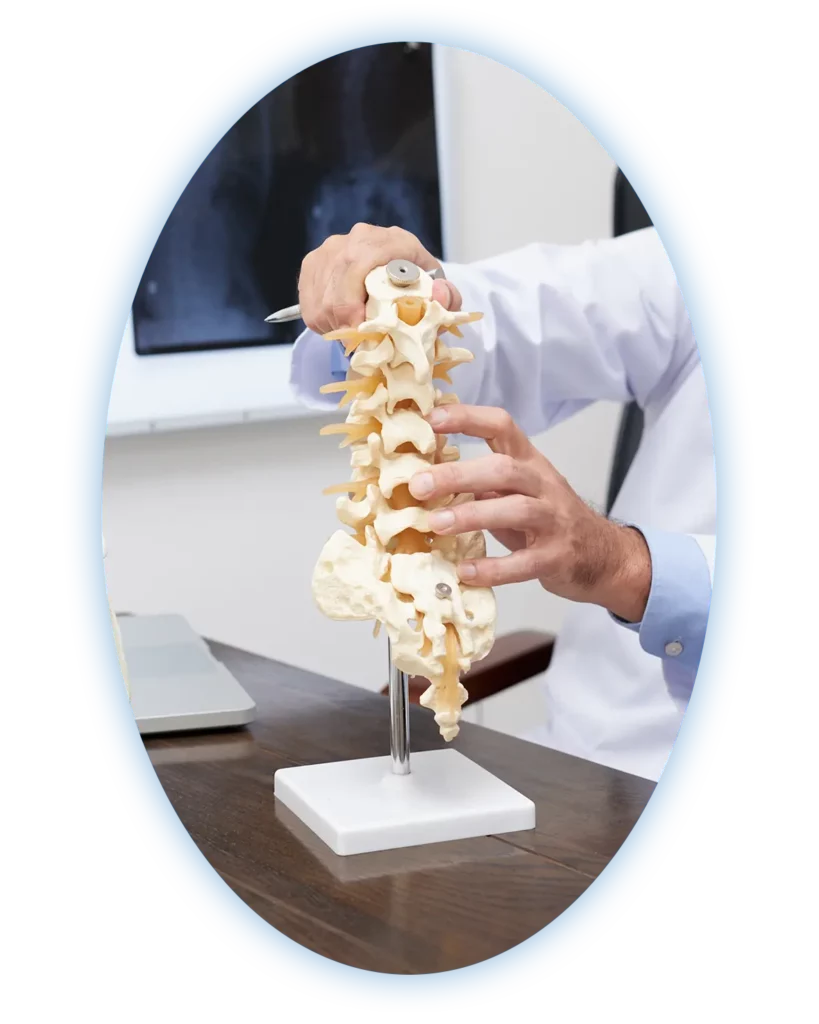
ACDF is a well-established procedure for problems of the cervical (neck) spine, but it is rarely the first step. Care begins with the least invasive options, and when surgery is needed we favor an ultra-minimally invasive or endoscopic approach wherever it can safely resolve the problem. ACDF is reserved for the cases those options cannot address.
Conditions ACDF treats
Considered before ACDF
ACDF is recommended when conservative care has not relieved symptoms and a less invasive procedure, such as endoscopic spine surgery, cannot safely address the problem, for example when the spinal cord is compressed, several levels are involved, or the segment needs to be stabilized. Your surgeon will always recommend the least invasive option appropriate for your condition.

ACDF is performed through the front of the neck, which lets the surgeon reach the spine without cutting through the muscles at the back of the neck.
You receive general anesthesia and are positioned comfortably on your back.
You are asleep and monitored throughout, the procedure itself is painless.
The surgeon makes a small incision, usually along a natural skin crease, and gently moves the muscles and other structures aside to reach the spine.
Muscle is preserved rather than cut, which supports a smoother recovery and a thin, discreet scar.
Guided by intraoperative X-ray, the damaged disc is removed, and any bone spurs pressing on the nerve or spinal cord are cleared.
This is the step that relieves the pressure causing pain, numbness, or weakness in the arm.
A spacer or bone graft is placed in the empty disc space, often secured with a thin titanium plate.
The spacer restores the disc height, keeping the nerve passageways open, and stabilizes the segment while it heals.
The incision is closed. Over the following months, the two vertebrae grow together into one solid segment.
The completed fusion provides lasting stability at the level that was causing symptoms.
Many ACDF procedures are performed on a same-day or short-stay basis. Your surgeon will review the specifics of your case, including how many levels are involved.
ACDF may be a good fit when the following are true, and when a less invasive route, such as endoscopic spine surgery, cannot safely resolve the problem. During your evaluation, we also review whether a motion-preserving option such as cervical disc replacement fits your spine.
Symptoms that follow a nerve pattern
Arm pain, numbness, tingling, or weakness that traces a path from the neck into the shoulder, arm, or hand.
Less invasive options aren’t enough
Symptoms persist despite conservative care, and a minimally invasive or endoscopic procedure can’t fully address the problem.
Imaging confirms the compression
MRI shows a herniated disc, stenosis, or bone spurs pressing on a nerve root or the spinal cord.
Signs of spinal cord involvement
Hand clumsiness or balance changes (myelopathy) often warrant earlier surgical evaluation.
More than one level is involved
ACDF is often preferred over disc replacement when multiple levels or significant arthritis are present.
Your overall health supports healing
General health matters for any surgery, and because smoking impairs fusion, we help patients plan around it.
Not sure where you stand? Send us a recent MRI and a board-certified specialist will review it, free.
Many patients return to light activity within a few weeks and to desk work within one to two weeks, then build up gradually. Because the fusion itself consolidates over several months, your surgeon will guide your activity, particularly lifting and high-impact exercise, during that time.
In many cases, yes. At Total Spine and Orthopedics, many ACDF procedures are performed on a same-day or short-stay basis, depending on your overall health and the number of levels treated. Your surgeon will tell you what to expect for your specific case.
Many patients notice their radiating arm pain ease soon after surgery, because the procedure removes the pressure on the nerve. Numbness or weakness can take longer to recover as the nerve itself heals, sometimes over weeks to months.
ACDF joins two vertebrae, which removes motion at that one segment. Most people do not notice a major change in overall neck movement, since the remaining levels of the neck continue to move normally. If preserving motion is a priority, cervical disc replacement may be an option worth discussing.
Some patients wear a soft collar for a short period for comfort and support while the area heals. Your surgeon will tell you whether one is needed and for how long, based on your procedure and the number of levels treated.
Mild soreness with swallowing or a scratchy throat is common in the first days after ACDF, because the surgeon works near the esophagus through the front of the neck. It typically improves within days to a few weeks. Difficulty that is severe or persistent should be reported to your surgeon.
At Total Spine and Orthopedics we favor the least invasive approach that will work, and for many disc problems that means an endoscopic or minimally invasive procedure through a tiny incision. ACDF becomes the better choice when those options can’t safely resolve the problem, for example when the disc must be reached from the front of the neck, when the spinal cord itself is compressed, when more than one level is involved, or when significant degeneration or instability means the segment needs to be stabilized with a fusion. Your surgeon recommends ACDF only when a less invasive option won’t do the job.
Both procedures remove a damaged cervical disc and relieve pressure on the nerve or spinal cord through the same small incision at the front of the neck. ACDF then fuses the two vertebrae into one solid segment, while cervical disc replacement implants an artificial disc that preserves motion at that level. The right choice depends on your anatomy, the number of levels involved, and the health of the surrounding spine, both are offered at Total Spine and Orthopedics.
ACDF has one of the longest and most consistent track records in spine surgery. For appropriately selected patients, it reliably relieves the arm pain, numbness, and weakness caused by nerve or spinal cord compression, and the vast majority of patients go on to a solid fusion. As with any surgery there are risks, which your surgeon will review with you.
Candidacy is determined by a clinical and neurologic examination combined with imaging, typically MRI, which shows the disc and any compression of the nerve roots or spinal cord at levels such as C5-C6 or C6-C7. Total Spine and Orthopedics offers a complimentary MRI review of your diagnosis and options. To schedule an evaluation in Melbourne, Orlando (Lake Nona), or Titusville, call (321) 499-4646.
Herniated and degenerative discs in the cervical spine cause symptoms by compressing a nerve root or the spinal cord. By removing that pressure, ACDF can relieve:
Cervical disc problems press on one of two structures, and the symptoms differ depending on which is involved.
Nerve root (radiculopathy)
Spinal cord (myelopathy)
Not sure which describes you? A clinical exam and MRI can tell, and our specialists will review your MRI for free.

Both procedures remove the damaged disc and relieve the pressure on the nerve or spinal cord through the same small incision at the front of the neck. They differ in what happens next.
Both procedures are performed at Total Spine and Orthopedics. Your surgeon will review your imaging with you and recommend the option that fits your spine, not the other way around.
Learn more about cervical disc replacement.
Every recovery is individual, but most ACDF patients follow a similar path. Your surgeon will tailor the timeline to your procedure and progress.
Many patients go home the same day or after a short stay. Some throat soreness and mild swallowing discomfort are normal; a soft collar may be provided for comfort.
Walk early and often. Gentle movement is encouraged from day one.
The incision heals and throat irritation fades. Many patients notice their arm pain has already eased, and many return to desk work in this window.
Keep activity light. No heavy lifting, and follow your surgeon’s guidance on driving.
Daily activity expands steadily. A first follow-up visit checks the incision and your progress.
Increase activity gradually as directed, and if you smoke, staying off it matters most now, because smoking impairs fusion.
The fusion consolidates into solid bone, confirmed with follow-up X-rays. Most patients return to full activity in this period.
Complete any prescribed physical therapy and build strength back at a steady pace.
Contact your care team promptly about severe or persistent swallowing difficulty, fever, new weakness, or drainage from the incision.
Hear our patients share their experience with us, All in their own words.
Expert, ultra-minimally invasive spine and orthopedic care, close to home.
Ultra-minimally invasive and endoscopic techniques
We specialize in procedures performed through incisions smaller than a dime, sparing muscle and supporting a faster recovery.
Same-day, outpatient procedures
Most patients walk in and return home within hours, rather than facing an overnight hospital stay.
Board-certified, fellowship-trained surgeons
Our team includes early leaders in endoscopic spine surgery.
A complimentary MRI review
Understand your diagnosis and options from a board-certified specialist before committing to any treatment.
Trusted by our community
More than 1,100 patient reviews at a 4.6-star average, and over 50,000 patients treated.
The least invasive option first
ACDF is reserved for cases that endoscopic or other minimally invasive procedures cannot safely resolve.
Comprehensive spine and orthopedic care
From injections to advanced procedures, your full continuum of care is handled in one place.
Convenient locations across the Space Coast and Orlando
Care close to home in Melbourne, Orlando (Lake Nona), and Titusville.