
Spondylolisthesis is a condition in which one vertebra slips forward over the vertebra below it. It most often affects the lower back, where it can cause low back pain and, when the slip narrows the space for the nerves, pain or numbness in the legs. Many cases are stable and managed without surgery; unstable or symptomatic slips can be treated with minimally invasive decompression and stabilization.

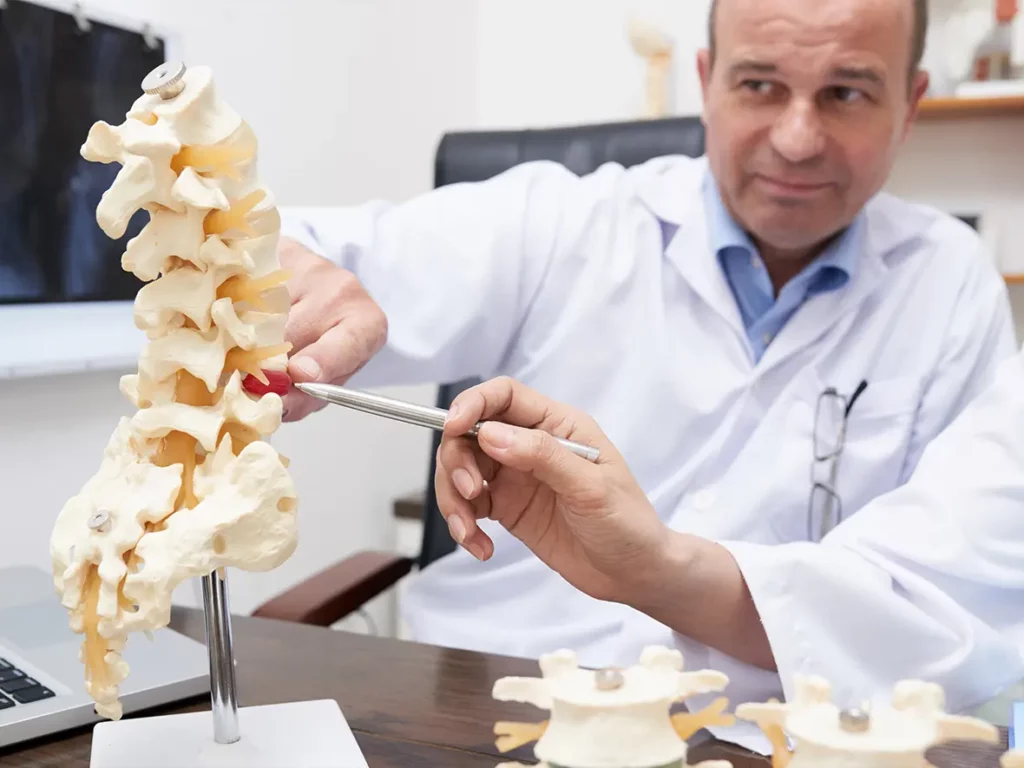
Many patients are treated without surgery first, and procedures are reserved for unstable slips or persistent nerve symptoms.
Non-surgical care
Minimally invasive procedures
Your surgeon will recommend the least invasive approach that fully addresses the slip and any nerve compression.

The cause depends on the type of spondylolisthesis. Common contributing factors include:
Facet joint and disc wear
The most common cause in adults, often alongside spinal arthritis.
Pars stress fracture
A fracture of the pars interarticularis allows the vertebra to slip (isthmic type).
Repetitive hyperextension
Sports such as gymnastics and football stress the lower spine.
Genetic and anatomic factors
Some people are born with features that make slippage more likely.
Trauma
An injury can fracture the structures that hold a vertebra in place.
Age and sex
The degenerative type is more common after 50 and in women.
Spondylolisthesis is graded by how far the upper vertebra has slipped forward over the one below. Most adults have a low-grade slip.
Grade I
Up to 25% slip
The most common grade. Usually managed without surgery.
Grade II
25 to 50% slip
More likely to narrow the canal and cause leg symptoms.
Grade III
50 to 75% slip
A high-grade slip that more often needs stabilization.
Grade IV
75 to 100% slip
Rare in adults; usually requires surgical treatment.
The grade is only one factor. Whether the segment is unstable and whether nerves are compressed matter as much as the amount of slip.
Many cases are mild and stable and are managed without surgery. It becomes more significant when the slip is unstable, progresses, or compresses a nerve and causes leg symptoms.
No. Most patients improve with physical therapy, activity modification, and sometimes injections. Surgery is considered when the slip is unstable or progressing, or when leg symptoms do not improve.
Degenerative spondylolisthesis develops later in life from facet joint and disc wear. Isthmic spondylolisthesis results from a stress fracture in the pars interarticularis, a small bridge of bone at the back of the vertebra, often from years earlier.
The grade describes how far the vertebra has slipped relative to the one below: grade I is up to 25 percent, grade II 25 to 50 percent, grade III 50 to 75 percent, and grade IV 75 to 100 percent. Most adults have grade I or II.
Degenerative spondylolisthesis most often occurs at L4-L5. Isthmic spondylolisthesis most often occurs at L5-S1.
Many patients remain active with an appropriate program. Core strengthening and avoiding repeated backward bending usually help. A specialist can advise which activities are appropriate for a specific case.
When surgery is needed, a minimally invasive decompression relieves pressure on the nerves, and a fusion such as transforaminal lumbar interbody fusion (TLIF) stabilizes the slipped segment.
Standing X-rays show the slip and its grade, and flexion-extension X-rays reveal whether the segment moves abnormally. MRI shows the discs and nerves. Total Spine and Orthopedics offers a complimentary MRI review; call (321) 499-4646 to schedule an evaluation.
Some people have no symptoms. When spondylolisthesis causes symptoms, common signs include:
The type of spondylolisthesis tends to determine the level involved.
Degenerative type
Isthmic type
Seek immediate care for progressive weakness, foot drop, numbness in the groin or inner thighs, or any loss of bladder or bowel control.

How ultra-minimally invasive and endoscopic procedures compare with traditional open surgery, and why most patients recover faster.
When spondylolisthesis needs surgery, minimally invasive decompression and fusion mean less muscle disruption, less pain, and a faster recovery than traditional open surgery.
Hear our patients share their experience with us, All in their own words.
Expert, ultra-minimally invasive spine and orthopedic care, close to home.
Ultra-minimally invasive and endoscopic techniques
We specialize in procedures performed through incisions smaller than a dime, sparing muscle and supporting a faster recovery.
Same-day, outpatient procedures
Most patients walk in and return home within hours, rather than facing an overnight hospital stay.
Board-certified, fellowship-trained surgeons
Our team includes early leaders in endoscopic spine surgery.
A complimentary MRI review
Understand your diagnosis and options from a board-certified specialist before committing to any treatment.
Trusted by our community
More than 1,100 patient reviews at a 4.6-star average, and over 50,000 patients treated.
A careful look at stability
We assess whether the slip is stable or progressing before recommending decompression, fusion, or continued conservative care.
Comprehensive spine and orthopedic care
From injections to advanced procedures, your full continuum of care is handled in one place.
Convenient locations across the Space Coast and Orlando
Care close to home in Melbourne, Orlando (Lake Nona), and Titusville.