
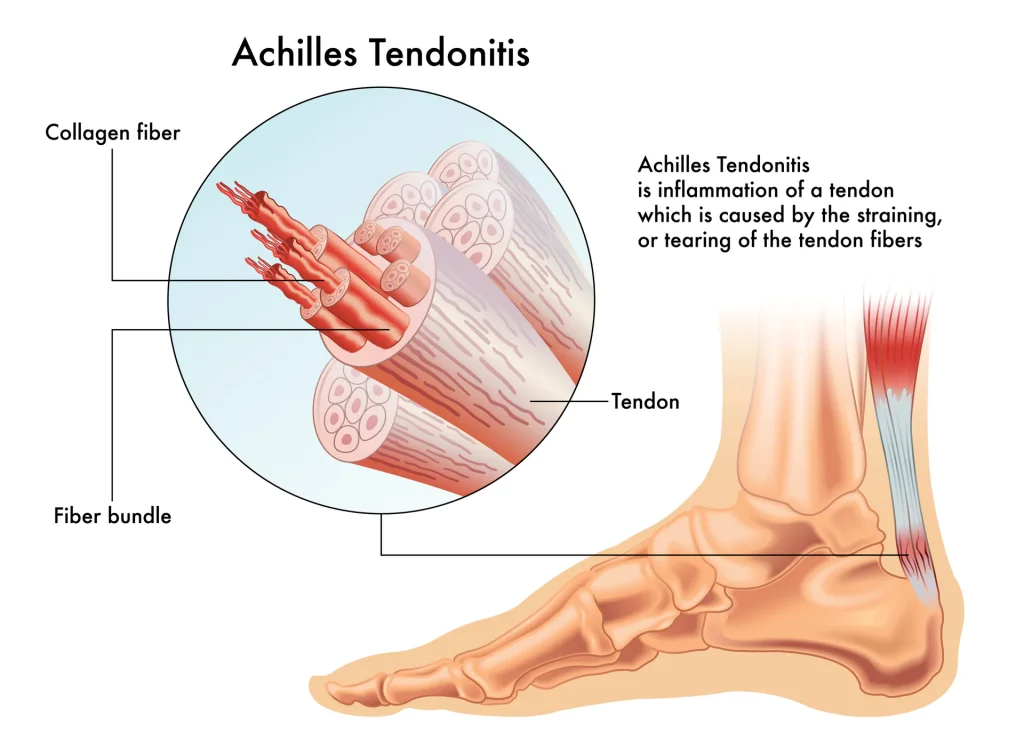
The Achilles tendon is the largest tendon in the body, connecting the calf muscles to the heel bone. It can weaken or tear from overuse, sudden injury, or degeneration. When conservative care does not restore function, Achilles tendon repair or reconstruction can restore strength, often as an outpatient procedure.

Our orthopedic specialists consider surgical repair or reconstruction when:
Complete rupture
The Achilles tendon is fully torn.
Chronic pain or weakness
Symptoms persist despite months of nonsurgical care.
Severe changes on imaging
Imaging shows degeneration or severe tearing.
An active lifestyle
You want to return to sports or demanding activities.

The exact technique depends on whether you need a repair or a reconstruction. In general:
A small incision
An incision is made along the back of the ankle.
Visualization
The torn or damaged tendon is carefully visualized.
Repair
The ends of the tendon are stitched back together with strong sutures.
Reconstruction, if needed
Tendon grafts are used to rebuild and reinforce the tendon.
Home the same day
Most surgeries are outpatient; some use minimally invasive or endoscopic techniques.
Recovery requires patience and dedication to rehabilitation. Your surgeon and physical therapy team will guide a structured plan.
Weeks 0 to 2
Protect
A splint or boot protects the repair; keep the leg elevated.
Weeks 2 to 8
Progressive loading
Weight bearing in a boot, advanced as directed.
Months 2 to 6
Strengthen
Physical therapy rebuilds calf strength and ankle motion.
6 months and beyond
Return to sport
Gradual return to demanding activities.
Healing times vary with the injury and whether repair or reconstruction was performed.
The Achilles tendon is the largest tendon in the body. It connects the calf muscles to the heel bone and plays a critical role in walking, running, and jumping.
A repair stitches a torn tendon back together, most often after an acute rupture. A reconstruction rebuilds a severely damaged, degenerated, or re-ruptured tendon using tendon transfers or grafts.
Surgery is considered for a complete rupture, chronic pain or weakness despite months of nonsurgical care, imaging showing severe tearing or degeneration, or active patients who want to return to sports.
Most Achilles procedures are performed on an outpatient basis, allowing patients to go home the same day. Some can be done with minimally invasive or endoscopic techniques.
Recovery requires patience and structured rehabilitation. Healing times vary with the severity of the injury and whether repair or reconstruction was performed, often several months before returning to sport.
Risks include infection or wound healing problems, nerve irritation or numbness near the incision, re-rupture, stiffness or loss of ankle motion, and a longer recovery for complex reconstructions.
Some ruptures are treated with a boot or cast and a structured rehabilitation program. Your surgeon will discuss whether surgical or non-surgical treatment is better for you.
A sudden pop or snap at the back of the ankle, sharp pain, and difficulty pushing off or standing on tiptoe are common signs. Call (321) 499-4646 for prompt evaluation.
Like all surgeries, Achilles procedures carry potential risks, including:

How minimally invasive foot and ankle surgery compares with traditional open surgery.
We minimize risks with advanced surgical techniques, careful wound management, and personalized rehabilitation plans.
Hear our patients share their experience with us, All in their own words.
Expert, ultra-minimally invasive spine and orthopedic care, close to home.
Ultra-minimally invasive and endoscopic techniques
We specialize in procedures performed through incisions smaller than a dime, sparing muscle and supporting a faster recovery.
Same-day, outpatient procedures
Most patients walk in and return home within hours, rather than facing an overnight hospital stay.
Board-certified, fellowship-trained surgeons
Our team includes early leaders in endoscopic spine surgery.
A complimentary MRI review
Understand your diagnosis and options from a board-certified specialist before committing to any treatment.
Trusted by our community
More than 1,100 patient reviews at a 4.6-star average, and over 50,000 patients treated.
Advanced foot and ankle procedures
Our surgeons treat both acute Achilles injuries and chronic tendon conditions.
Comprehensive spine and orthopedic care
From injections to advanced procedures, your full continuum of care is handled in one place.
Convenient locations across the Space Coast and Orlando
Care close to home in Melbourne, Orlando (Lake Nona), and Titusville.