
Spinal stenosis is a narrowing of the spaces within the spine that crowds the spinal cord and nerves. In the lower back it commonly causes leg pain, heaviness, or cramping with standing and walking; in the neck it can affect the arms and hands. Many patients improve with conservative care, and minimally invasive decompression can relieve the pressure when symptoms persist.

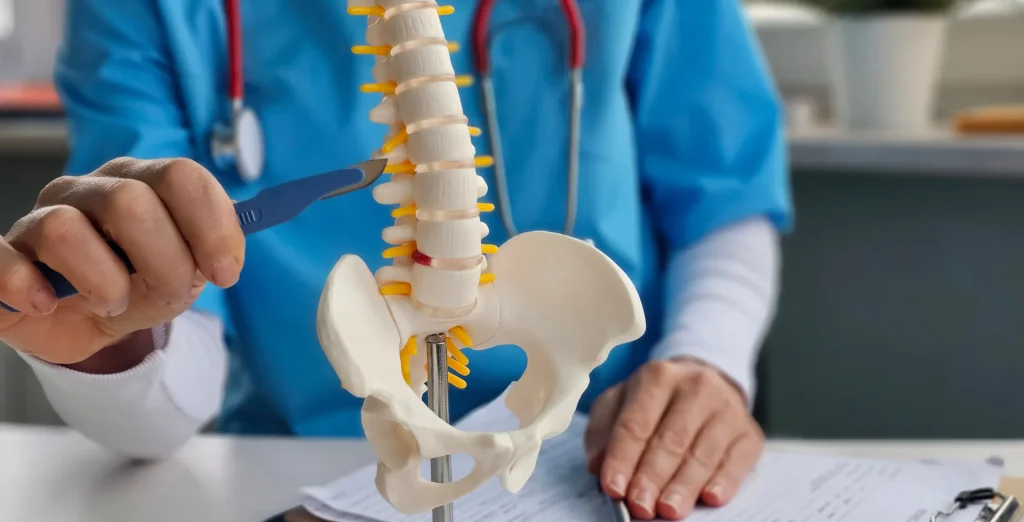
Many patients improve with conservative care, so treatment begins with the least invasive options and advances only as needed.
Non-surgical care
Minimally invasive procedures
Most procedures are performed same-day, on an outpatient basis. Your surgeon will recommend the least invasive option appropriate for your condition.

Spinal stenosis usually develops gradually as several age-related changes narrow the canal together. Common contributing factors include:
Spinal arthritis and bone spurs
Enlarged facet joints and osteophytes encroach on the canal.
Thickened ligament
The ligamentum flavum stiffens and thickens with age, crowding the nerves from behind.
Disc material can narrow the canal from the front.
A vertebra slipping forward narrows the canal at that level.
Loss of disc height narrows the openings where nerves exit.
Congenital narrowing
Some people are born with a smaller canal and develop symptoms earlier.
Leg pain with walking (claudication) can come from compressed nerves or from narrowed arteries. The pattern of relief helps tell them apart.
Neurogenic claudication
From spinal stenosis
Nerves are compressed in the spine
Vascular claudication
From poor circulation
Arteries in the legs are narrowed
An evaluation can confirm the source. When the cause is spinal stenosis, treatment focuses on giving the compressed nerves more room.
In the lower back, spinal stenosis typically causes pain, heaviness, or cramping in the legs that comes on with standing or walking and eases with sitting or leaning forward. In the neck, it can cause arm symptoms and, in more advanced cases, problems with balance or fine hand movements.
Not always. Many patients manage symptoms with physical therapy, anti-inflammatory medication, and epidural steroid injections. Minimally invasive decompression is considered when symptoms persist or limit walking despite these measures.
The narrowing itself does not reverse on its own, but the symptoms can often be relieved effectively. Conservative care helps many patients, and minimally invasive decompression reopens the space around the nerves when needed.
Flexing the lower spine slightly forward enlarges the spinal canal and the openings for the nerves, giving crowded nerves more room. This is why many patients feel better leaning on a shopping cart or sitting down.
Spinal stenosis usually refers to narrowing of the central spinal canal, which can affect several nerves at once. Foraminal stenosis is narrowing of the side openings (foramina) where a single nerve root exits the spine. The two often occur together.
Staying active is generally beneficial, although upright walking may provoke symptoms. Many patients tolerate a stationary bike, walking with a cart, or aquatic exercise better, because these positions keep the spine slightly flexed. A physical therapist can tailor a program.
The mild procedure is a minimally invasive treatment for lumbar spinal stenosis caused largely by a thickened ligament. Through a very small opening, excess ligament tissue is removed to restore space in the canal, without implants or stitches.
In most cases, yes. The majority of minimally invasive decompression procedures at Total Spine and Orthopedics are performed on a same-day, outpatient basis. To schedule an evaluation in Melbourne, Orlando (Lake Nona), or Titusville, call (321) 499-4646.
Symptoms tend to develop gradually and depend on where the narrowing is. Common signs include:
Stenosis most often affects the lower back, and less commonly the neck.
Lumbar (lower back)
Cervical (neck)
Seek immediate care for worsening weakness, difficulty walking or with balance, or any loss of bladder or bowel control.

How ultra-minimally invasive and endoscopic procedures compare with traditional open surgery, and why most patients recover faster.
When spinal stenosis needs a procedure, minimally invasive decompression means less pain, a smaller scar, and a faster return to walking and everyday life.
Hear our patients share their experience with us, All in their own words.
Expert, ultra-minimally invasive spine and orthopedic care, close to home.
Ultra-minimally invasive and endoscopic techniques
We specialize in procedures performed through incisions smaller than a dime, sparing muscle and supporting a faster recovery.
Same-day, outpatient procedures
Most patients walk in and return home within hours, rather than facing an overnight hospital stay.
Board-certified, fellowship-trained surgeons
Our team includes early leaders in endoscopic spine surgery.
A complimentary MRI review
Understand your diagnosis and options from a board-certified specialist before committing to any treatment.
Trusted by our community
More than 1,100 patient reviews at a 4.6-star average, and over 50,000 patients treated.
The smallest procedure that relieves symptoms
From the mild procedure to laminotomy, we match the decompression to the source of the narrowing.
Comprehensive spine and orthopedic care
From injections to advanced procedures, your full continuum of care is handled in one place.
Convenient locations across the Space Coast and Orlando
Care close to home in Melbourne, Orlando (Lake Nona), and Titusville.