
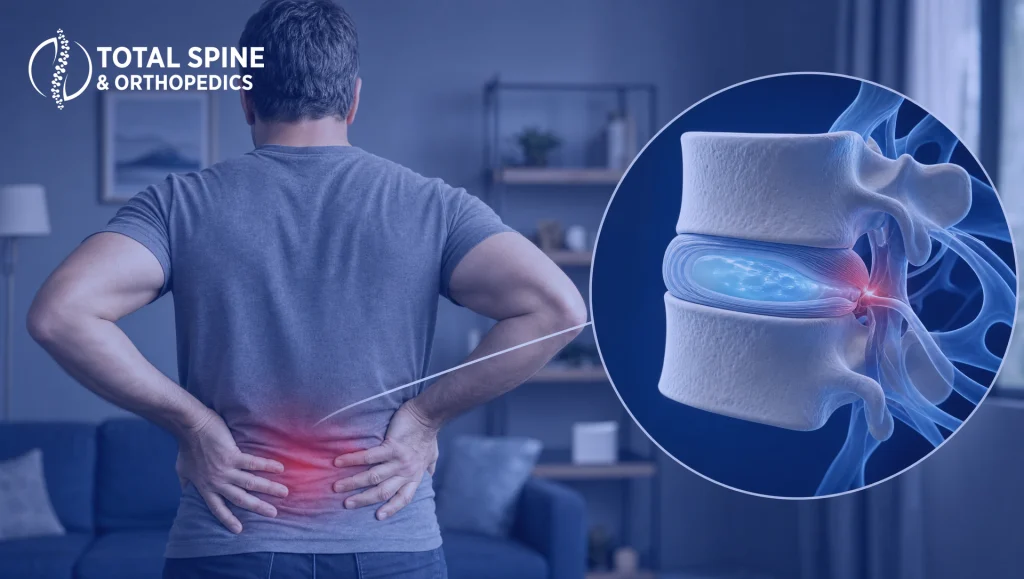
When people think of lower back problems, they usually picture the bottom of the spine, levels like L4-L5 and L5-S1 that cause classic sciatica. But the upper lumbar spine has its own story. The L1-L2 segment sits at the top of the lower back, just below the ribcage, and when something goes wrong here, the symptoms often surprise patients: instead of pain shooting down the back of the leg, L1-L2 problems tend to wrap around the hip into the groin or the front of the thigh.
Because these symptoms don’t match what most people expect from a spine problem, L1-L2 conditions are frequently mistaken for hip trouble, a pulled muscle, or even a hernia. Understanding this level, and getting an accurate diagnosis, is the first step toward real relief.
Understanding the L1-L2 Region
The lumbar spine consists of five vertebrae, L1 through L5. The L1 and L2 vertebrae sit at the very top of that column, in a transition zone called the thoracolumbar junction, where the stiff, rib-anchored thoracic spine meets the flexible lumbar spine. Transition zones concentrate mechanical stress, which is why this area is a common site of injury after falls and car accidents and a frequent location for age-related wear.
A Level That Deserves Extra Respect
L1-L2 has one more distinction: the spinal cord itself ends near this level, at a structure called the conus medullaris, before branching into the bundle of nerve roots that serve the legs. Because of this anatomy, significant compression at L1-L2 can affect bowel, bladder, or groin sensation. Those symptoms are rare, but if they occur, they are a medical emergency, and you should seek care immediately.
Why L1-L2 Pain Feels Different From Sciatica
The nerve roots that exit at the upper lumbar levels supply sensation to the groin and the front of the thigh, and they help power the hip flexor and thigh muscles. That is why an irritated nerve at L1-L2 typically causes:
- Pain across the upper part of the lower back, sometimes wrapping around the flank like a band
- Burning, tingling, or numbness in the groin or the front of the thigh
- Weakness when lifting the leg or climbing stairs (hip flexor weakness)
- Discomfort that worsens with standing or arching backward
Compare that with sciatica, which travels down the back of the leg toward the foot. If your leg pain runs down the front of your thigh instead of the back, the upper lumbar spine is one of the first places a specialist will look.
Common Conditions Affecting L1-L2
Herniated or Bulging Disc
Disc herniations at L1-L2 are much less common than at the lower lumbar levels, but they do happen, and they occur more often in older adults, whose discs have stiffened with age. A herniated disc here can press on the exiting nerve roots or, in severe cases, the conus medullaris itself, which is why upper lumbar herniations are taken seriously even when they are small.
Degenerative Disc Disease
As discs lose hydration over time, the L1-L2 disc can flatten and become a source of aching, stiffness, and morning discomfort. Because the thoracolumbar junction absorbs so much stress, degeneration here often shows up alongside changes at neighboring levels.
Spinal and Foraminal Stenosis
Bone spurs, thickened ligaments, and disc bulges can narrow the spinal canal or the openings where nerves exit (foraminal stenosis). At L1-L2, stenosis may cause pain or numbness in the thighs that worsens with standing and eases when sitting or leaning forward.
Facet Joint Arthritis
The paired facet joints at the back of each spinal level can develop arthritis just like a knee or hip. Facet-related pain at L1-L2 is usually a localized ache that flares when you arch or twist, and it responds well to targeted, image-guided treatments.
Compression Fractures
The thoracolumbar junction is the most common site in the spine for compression fractures, especially in patients with osteoporosis. Sudden upper lumbar pain after a fall, or even after something as minor as a hard cough in someone with thinning bones, deserves prompt imaging and evaluation by a spine specialist.
How L1-L2 Problems Are Diagnosed
Because upper lumbar symptoms mimic hip and groin conditions, an accurate diagnosis matters more here than almost anywhere else in the spine. Your evaluation will typically include a physical exam of your strength, reflexes, and sensation, along with imaging. An MRI shows the discs and nerves in detail, while X-rays and CT scans reveal alignment and bone quality. In some cases, a precisely placed diagnostic injection is used to confirm exactly which structure is generating the pain.
Already have imaging? Total Spine and Orthopedics offers a free MRI review, where our specialists will examine your scan and give you a clear explanation of what is happening at L1-L2 and what your options are.
Non-Surgical Treatments Come First
The majority of L1-L2 conditions improve without surgery. Depending on the diagnosis, your plan may include:
- Physical therapy: Core strengthening and flexibility work that unloads the thoracolumbar junction.
- Medications: Short courses of anti-inflammatories to settle painful flare-ups.
- Epidural steroid injections: Image-guided medication delivered directly to the inflamed nerve root.
- Facet injections and radiofrequency ablation: For arthritis-related pain, these treatments calm or quiet the small nerves that carry pain signals from the facet joints, often providing months to years of relief.
- Bracing: Temporary support that can ease pain and protect the spine while an injury heals.
Minimally Invasive Surgical Options at L1-L2
If conservative care has run its course, or if nerve compression is causing weakness or numbness that will not let up, surgery at L1-L2 can be performed through remarkably small incisions:
- Endoscopic discectomy: Through an incision smaller than a dime, a high-definition camera guides the removal of the herniated disc fragment pressing on the nerve.
- Laminotomy and foraminotomy: Keyhole decompression procedures that create more room for the spinal canal or the exiting nerve root while preserving the surrounding structure.
- TLIF (Transforaminal Lumbar Interbody Fusion): When instability is part of the problem, a minimally invasive fusion stabilizes the segment through small incisions with minimal muscle disruption.
Given the conus medullaris’ location, upper lumbar procedures demand precision and experience, one more reason to choose a practice that performs minimally invasive spine surgery every day.
Recovery After L1-L2 Treatment
Most patients who undergo minimally invasive decompression at L1-L2 walk within hours and go home the same day. Physical therapy typically begins within a few weeks, focusing on core strength and body mechanics to protect the thoracolumbar junction long-term. Even after fusion procedures, minimally invasive techniques mean less blood loss, less post-operative pain, and a faster return to daily life than traditional open surgery.
Frequently Asked Questions About L1-L2
Why does my back problem cause groin and thigh pain instead of leg pain?
The nerves that exit the spine at the upper lumbar levels travel to the groin and the front of the thigh, not down the back of the leg. Pain follows the path of the irritated nerve, so L1-L2 problems produce a very different pattern than the sciatica caused by lower levels.
Is an L1-L2 disc herniation serious?
Most improve with conservative treatment, just like herniations elsewhere in the spine. However, because the spinal cord ends near this level, new bowel or bladder changes, groin numbness, or rapidly progressing leg weakness should be evaluated immediately.
When is surgery needed for an L1-L2 problem?
Surgery is considered when six or more weeks of comprehensive non-surgical care hasn’t controlled the pain, or sooner if there is significant weakness or pressure on the nerves. Most procedures at this level can be done through small incisions on an outpatient basis.
Why Choose Total Spine and Orthopedics?
Our board-certified surgeons specialize in ultra-minimally invasive and endoscopic spine care, treating every level of the spine, including the upper lumbar levels that are so often misdiagnosed. With offices in Melbourne and Lake Nona (Greater Orlando), expert spine care is close to home for patients across Central Florida and the Space Coast.
If upper back pain, groin numbness, or front-of-thigh symptoms are holding you back, get answers. Call 321-499-4646 or schedule online today, and ask about our free MRI review.
Note: This article is for informational purposes and does not replace the advice of a licensed physician. Please consult with a licensed physician before attempting any treatment regimen.
Take Back Your Quality of Life!