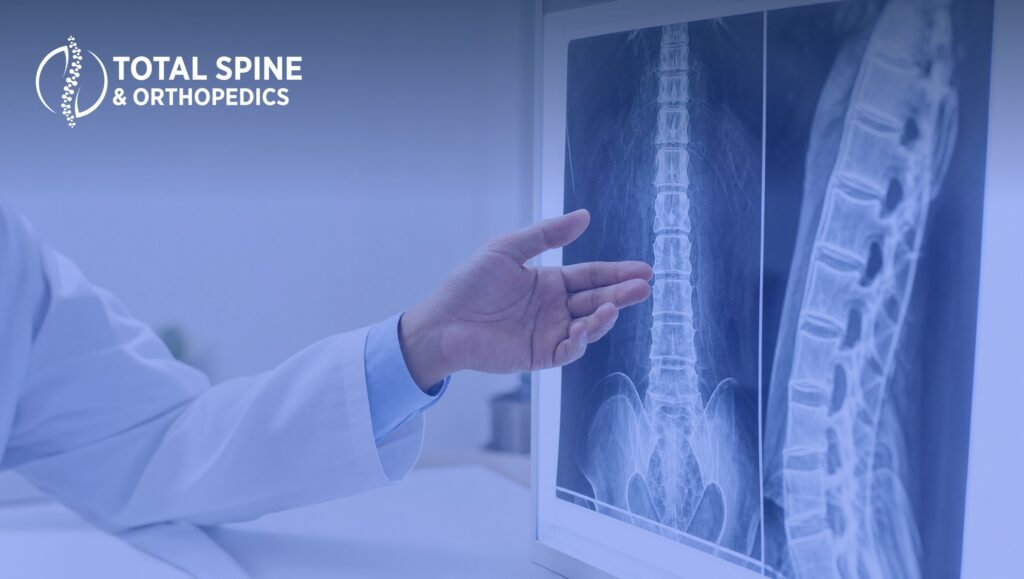
If you have ever read your own X-ray report, you know the feeling. The results are full of long words, Latin roots, and phrases like “degenerative changes” and “mild anterolisthesis” that can sound alarming when you do not know what they mean. It is easy to assume the worst.
Here is the reassuring truth: many of the terms on an imaging report describe normal, age-related changes that are common and very treatable, and a finding on a scan is not the same as a diagnosis. This glossary translates the most common spine and orthopedic joint terms into plain English so you can read your report with less worry and better questions. Think of it as a decoder, not a diagnosis. Only a physician who examines you and connects your images to your actual symptoms can tell you what your report means for you.
How an X-Ray Report Is Organized
Before the terms, it helps to know the structure. Most reports have two parts:
- Findings is the detailed list of everything the radiologist observed, including the boring, normal stuff.
- Impression is the short summary at the end. This is usually the most important part, where the radiologist highlights what actually stands out.
You may also see the views that were taken, such as AP (front to back), lateral (from the side), and oblique (at an angle). And you will often see severity words like mild, moderate, and severe, which describe how advanced a change is. “Mild” findings are extremely common and frequently cause no symptoms at all.
Common Spine Terms on an X-Ray Report
Degenerative Disc Disease and Disc Space Narrowing
Despite the word “disease,” this describes the normal wear that discs undergo over a lifetime. As a disc loses height and hydration, the space between two vertebrae narrows, which the report may call “disc space narrowing” or “disc space loss.” It is one of the most common findings on adult spine imaging and often causes no pain at all.
Osteophytes (Bone Spurs) and Spondylosis
Osteophytes are small, smooth growths of extra bone, commonly called bone spurs, that form as a joint adapts to wear over time. When a report uses the umbrella term spondylosis, it is simply referring to this general age-related arthritis of the spine. You can read more about arthritis of the spine and how it is managed.
Spondylolisthesis, Anterolisthesis, and Retrolisthesis
These terms describe one vertebra that has slipped out of line with the one below it. Anterolisthesis means it has shifted forward, and retrolisthesis means it has shifted backward. Reports usually grade the slip from 1 (mild) to 4. Many low-grade slips are stable and are managed without surgery.
Facet Arthropathy or Facet Hypertrophy
The facet joints are the small joints at the back of the spine that guide movement. Facet arthropathy means arthritis in these joints, and hypertrophy means they have enlarged as they wear. This is a very common source of back and neck stiffness that often responds well to conservative care.
Foraminal Narrowing and Stenosis
The foramina are the small openings where nerves exit the spine. When they narrow, the report may say “foraminal narrowing” or “foraminal stenosis,” and if a nerve is being pinched, it can cause pain, numbness, or tingling that travels into an arm or leg. Learn more about foraminal stenosis and the treatment options for it.
Scoliosis, Kyphosis, and Lordosis
These describe the curve of the spine. Scoliosis is a side-to-side curve, while kyphosis (rounding) and lordosis (inward curve) refer to the front-to-back shape. Some degree of curve is normal, and reports flag it when it is more pronounced than expected. See our overview of scoliosis for more.
Compression Fracture
This means a vertebra has lost height, often from a fall or from weakened bone. On a report it may appear as a “compression deformity” or “wedge deformity.” Compression fractures should always be evaluated by a physician, who can guide treatment such as activity changes, bracing, and pain management based on your situation.
Common Orthopedic Joint Terms (Knee, Hip, Shoulder, and More)
Osteoarthritis, DJD, and Joint Space Narrowing
Osteoarthritis, sometimes written as degenerative joint disease (DJD), is the gradual wearing of the cartilage that cushions a joint. On an X-ray it usually shows up as joint space narrowing, because thinning cartilage lets the bones sit closer together. It is the most common form of arthritis. Read more about osteoarthritis and how it is treated.
Subchondral Sclerosis and Cysts
Subchondral sclerosis is a hardening of the bone just beneath the cartilage, and small subchondral cysts can form nearby. Both are common signs that a joint is coping with extra stress, and they typically appear alongside arthritis.
Joint Effusion
An effusion is extra fluid in or around a joint, which the report may describe as soft-tissue swelling. It is the body’s response to irritation or injury and points your physician toward the underlying cause.
Fracture Descriptors
If there is a break, the report describes its pattern. Nondisplaced means the pieces are still lined up, while displaced means they have shifted. Comminuted means the bone broke into several pieces, avulsion means a small fragment was pulled off by a tendon or ligament, and hairline or stress fracture means a thin crack, often from repetitive impact.
Chondrocalcinosis and Calcification
Chondrocalcinosis refers to calcium deposits within cartilage, and calcification can appear in tendons or other soft tissue. These are common with age and are sometimes linked to specific types of joint inflammation your physician can evaluate.
Malalignment: Varus and Valgus
These describe the angle of a joint. Varus and valgus simply note that a bone is angled inward or outward relative to normal. In the knee, for example, this is the language behind “bow-legged” or “knock-kneed” alignment.
Osteopenia and Osteoporosis
These terms describe reduced bone density. Osteopenia is mild thinning, and osteoporosis is more significant. An X-ray can suggest low bone density, but a dedicated bone-density (DEXA) scan is used to confirm and measure it.
Hardware, Prosthesis, and Loose Bodies
If you have had surgery, the report will note hardware (screws, plates, or rods) or a prosthesis (an artificial joint) and comment on whether it looks well positioned. Loose bodies are small floating fragments of bone or cartilage inside a joint.
Everyday Words That Sound Scarier Than They Are
- Unremarkable is good news. It means nothing abnormal was seen.
- No acute findings means no new or urgent problem such as a fresh fracture.
- Degenerative changes is a catch-all for normal, age-related wear, not a specific disease.
- Age-appropriate or age-indeterminate means a finding fits what is expected for your age or cannot be dated precisely.
An Abnormal Finding Does Not Always Mean Surgery
This is the most important thing to remember. Imaging findings like disc narrowing, bone spurs, and mild arthritis are extremely common in people who have no pain at all. Studies of pain-free adults routinely find these same “abnormalities” on their scans.
That is why a good specialist never treats the image alone. What matters is whether your imaging findings line up with your actual symptoms, your exam, and your daily life. Two people can have identical reports and need completely different plans, or no treatment at all. At Total Spine and Orthopedics, our recommendations are individualized, and we start with the least invasive option that is likely to work, from physical therapy to other non-surgical treatment options, long before surgery is ever on the table.
What to Do With Your Report
If your report has you concerned, the best next step is to have it explained by a specialist who can connect the words on the page to what you are actually feeling. Understanding your diagnostic imaging is part of building the right plan.
If you already have imaging from another provider, our free MRI review is a straightforward, no-obligation way to get a clear, honest explanation of what your images show and what your realistic options are.
Frequently Asked Questions
Does a finding on my X-ray mean I need surgery? Almost never on its own. Many reported findings are normal, age-related changes that cause no symptoms. Surgery is considered only when your symptoms, exam, and imaging all point to a problem that has not responded to conservative care, or when there is an urgent issue. The image is one piece of the picture, not the whole story.
What is the difference between the “Findings” and the “Impression”? The Findings section lists everything the radiologist observed, including normal details. The Impression is the short summary at the end that highlights what actually stands out. If you only read one part, read the Impression, then ask your physician to walk you through it.
My report says “degenerative changes.” Is that serious? Usually not by itself. “Degenerative changes” is a general term for the normal wear that builds up over the years, and it is one of the most common phrases on adult imaging. What matters is whether those changes are causing your symptoms, which is exactly what a specialist evaluates.
Why Choose Total Spine and Orthopedics?
Patients across Melbourne, Lake Nona, and the greater Orlando area trust Total Spine and Orthopedics because our focus is simple: understanding the real cause of your symptoms and getting you back to your life. Our board-certified, fellowship-trained physicians take the time to explain your imaging in plain language and specialize in ultra-minimally invasive techniques, so when treatment is needed, you get relief with less disruption and a faster recovery whenever possible. With more than 50,000 patients treated and a 4.6-star rating across more than 1,100 reviews, we have earned the trust of our community one patient at a time.
Get a Clear Explanation of Your Imaging
You should never have to guess at what your own X-ray or MRI means. The right explanation is the start of the right plan.
Call Total Spine and Orthopedics at (321) 499-4646 to schedule a consultation at our Melbourne or Lake Nona location, or request your free MRI review for a clear, no-obligation look at what your images actually show. Let us help you understand your results and your options.
This article is for general educational purposes only and is not a substitute for professional medical advice, diagnosis, or treatment. Always consult a qualified healthcare provider about your imaging results and any medical condition.
Take Back Your Quality of Life!